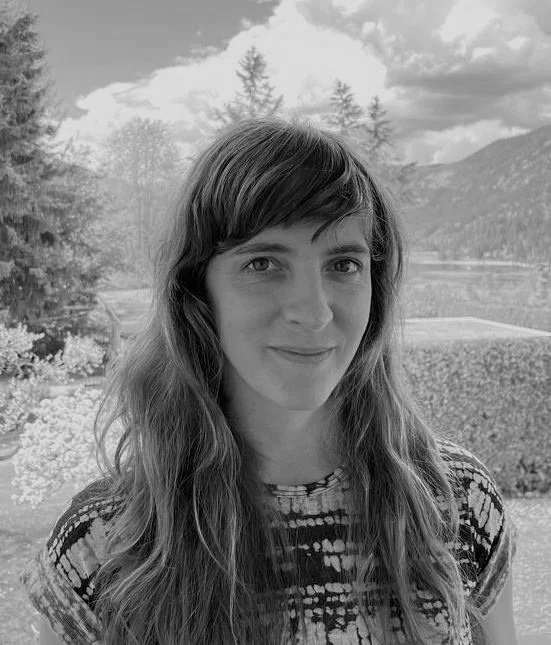
Genevieve Robertson is an ecologically engaged interdisciplinary artist. Her practice is grounded in both material and embodied research, which often develops into large-scale and long term hybrid drawing/painting/multidisciplinary projects. Through this work she explores industrial and settler-colonial impacts on land, water and living beings, and the intelligence and interconnection of the life systems of which we are part. She works in critical conversation with imperial legacies of landscape representation and scientific illustration, and is informed by drawers, painters, poets, scientists, Indigenous and eco-feminist theorists, among many other thinkers and makers. Genevieve is influenced by a personal and intergenerational history of forestry labour in remote areas of British Columbia. Born in Vancouver, Genevieve is a dual British/Canadian of mixed European settler ancestry. She currently lives and works in the West Kootenays, on the unceded territory of the sn̓ʕay̓ckstx (Sinixt) Arrow Lakes and Yaqan Nukiy peoples with her family. Alongside her solo practice, Genevieve works on various collaborative projects, mentors emerging artists, and teaches part-time at Emily Carr University.
Robertson holds a BFA from NSCAD University (Halifax) and an MFA from Emily Carr University (Vancouver). She has been supported through exhibitions, symposia, and residencies internationally, most recently at the Midlands Arts Centre (Birmingham UK), Orange County Museum of Art (Los Angeles), the Oceanside Museum of Art (Los Angeles), SBC Gallery (Montréal), The Works on Water Triennial (New York), Sitka Center for Art and Ecology (Oregon), the Morris and Helen Belkin Gallery (Vancouver), Walter Phillips Gallery (Banff), Access Gallery (Vancouver), the Burnaby Art Gallery, and the Gordon Smith Art Gallery (North Vancouver). Her work has been published with the Centre for Alterity Studies (UK), The Society for the Diffusion of Useful Knowledge (ON), and The Dark Mountain Project (UK). It is also featured in Outdoor School (Douglas and McIntyre), Art and Climate Change (Thames and Hudson), and Ecologies in Practice: Environmentally Engaged Arts in Canada (Wilfrid-Laurier University Press).
She is grateful to the Canada Council for the Arts, the British Columbia Arts Council, and the Columbia Kootenay Cultural Alliance for their generous support, and to all the places, people, organizations and institutions that have made her work possible.